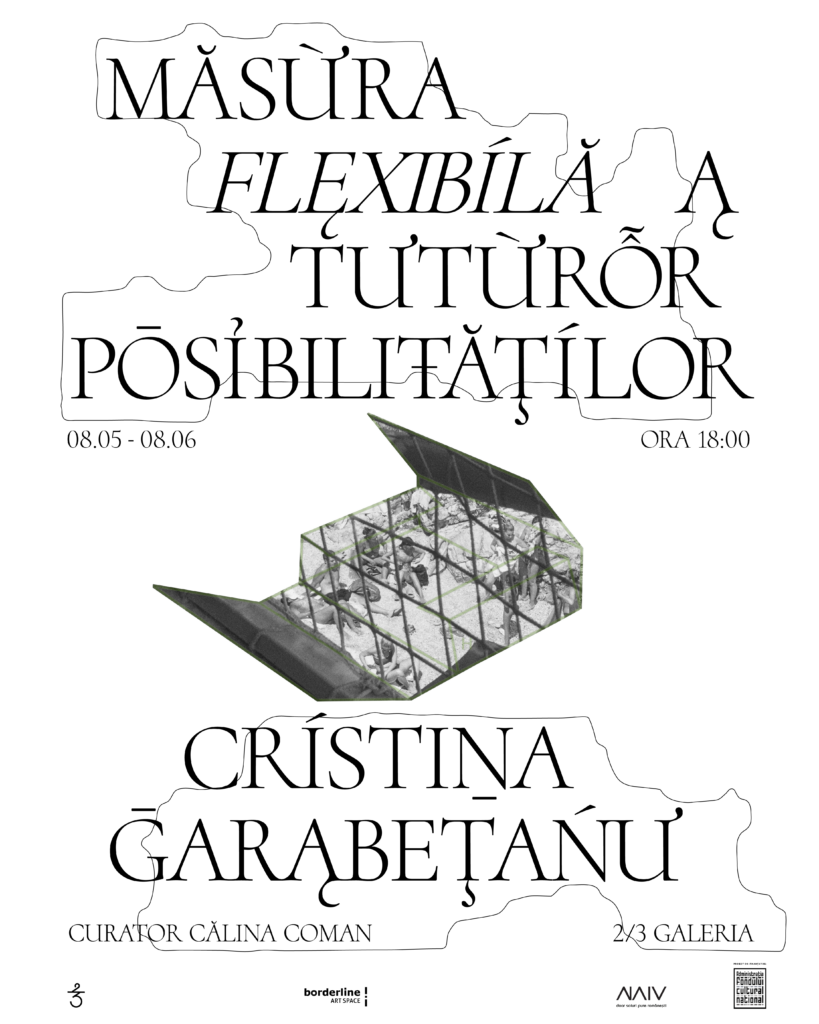
THE FLEXIBLE MEASURE OF ALL POSSIBILITIES
2/3 Gallery
Curated by: Călina Coman
08 May – 08 June 2025
“The gaze, we said, envelops, palpates, adheres to things. As if it were in a relationship of pre-established harmony with them, as if it knew them before knowing them. The gaze moves in its own way, in its staccato and imperious style, yet its perspectives are not arbitrary; I do not look at chaos, but at things, so that ultimately we cannot say who commands—the gaze or the things.” — Merleau-Ponty
Like any other contemporary project built on solid foundations, this exhibition begins with the accumulation of needs: to discover more, more clearly, and in greater detail, truths about one’s own past. Originally from Constanța, Cristina Garabețanu attended an arts-focused high school—a period that marked the emergence of her interest in photography—before continuing her university studies in Bucharest, in the painting department. This brief biographical note matters insofar as the pictorial quality of the image diffuses through the presented works, whether we’re looking at the photography series or objects. Her intimist approach, that of an archivist-voyeur-creator, and her transdisciplinary methods of physically grounding large-scale research manifest themselves in what follows through a geometric framework with telluric chromatic accents.
The genesis of this exhibition is, to some extent, dual. Prompted by the numerous times her family name has been mangled, Cristina Garabețanu begins to search for when, in her family’s history, the “e” disappeared, when the “ț” transformed into “d,” and what traces her great-great-grandparents left behind. The decision to outline one’s genealogical tree is often driven by an interior desire, most frequently sustained by deeply personal or cultural motives. Some people begin constructing their family tree out of a need to understand themselves better—as if, to understand one’s own story, one must first listen to those who went silent before. Others do it to repair a rupture—a forgotten memory, a fragmented family, a past that has been hidden, lost, or neglected. Genealogy, as a form of reconnection, becomes an attempt to sew words and images over a void, and perhaps, as they draw the lines connecting names, places, and years, people aren’t just seeking a map of the past, but a kind of compass for the present. A family tree, more than a tangled diagram, is a form of conversation with time, an attempt to write a script of personal becoming.
Ultimately, the reconstruction of such a familial trajectory is based on a need for anchoring, a form of structuring the self in time, and reconnecting with one’s own roots, especially in contexts of migration, exile, uprooting—a fact that Cristina Garabețanu discovers about herself precisely in this cultural inheritance with Armenian, Greek, possibly Roma origins, which she unpacks and unfolds with the idea of viewing a micro-history on an expanded plane. The key moment that symbolically marks the construction of the series Lies for the Liars, Clarity for the Seekers (2025) is the direct action of heading toward the box of family photographs, the “factual” verification of personal history.
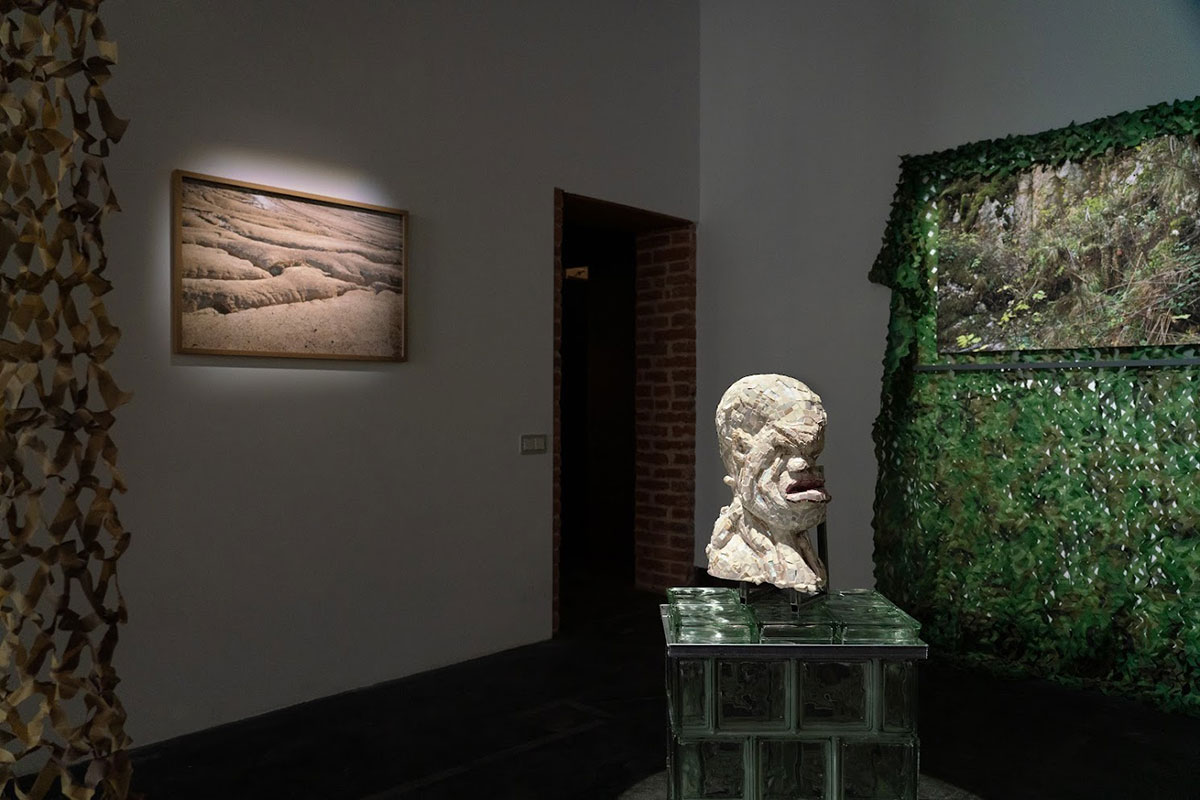
Over analog photographs taken on beaches near Antalya, in the traces of rocky sites where she captures people in a freeze-frame of life—Garabețanu intervenes with diluted construction lines and orientation markings that constitute the flat surface from which a box is constructed. In the affective and cultural imaginary, the box is an enclosed space that promises to conserve, protect, hide, preserve something that must remain in its state from a certain moment in time. These line constructions refer to the idea of matrix—an originary, interior space from which a story, an identity, a form of reconstitution can spring forth. Viewed as the symbolic structure of a fertile territory from which something can take shape, the deconstructed, disassembled box functions as a liminal space, situated between visible and invisible, a space of hypotheses that maintains an elastic unity of potentialities. In other words, it can be read as an attempt to unfold the past onto the plane of the present. On another note, the box symbol also has its representation at the opposite pole in this exhibition. The closed box, the pedestal constructed from pieces of glass brick, is a deliberate choice regarding the notion of hidden truth, which speaks through material rather than through functionality. The transparency carried by the robustness of the object can be viewed as a form of lucid archiving in which memory remains suspended in a regime of controlled visibility, which contains without revealing, inscribing itself in a type of aesthetics of suggestion (otherwise present throughout the entire exhibition). This way of looking—suggested, flexible, at times ambiguous—brings unstable forms into dialogue as they seek their balance in motion.
Starting from the significance of the lines superimposed over the image, each of the two walls projects, to some extent, the same reading grid, to which, however, imaginary oblique and diagonal lines are added. An important aspect in the exhibition’s construction is precisely this predisposition toward crossed correspondences, between black-and-white images, focused on characters and landscapes that could be anywhere, universal, and color images with the character hidden or, rather, camouflaged in grasslands or desert zones, part of the series Line of Thought (2025). Each image functions as an index of a topo-affective space, a geographical space that stands as proof that, in the grand scheme of things, whether we think of cultural identity, personal history, affective reality, or the process of becoming—there are unclear, unstable, visible yet non-revelatory elements.
Thus, the primary instrument we can use in unraveling and threading together a trajectory of humanity through time remains the gaze. Merleau-Ponty brings into discussion the act of looking in a dialectic strongly connected to one of the themes of this exhibition: palpating with the eye, the tactile dimension of the gaze; because, beyond granularity, enlarged image, subsequent manipulation in a connected medium, Cristina Garabețanu activates the materiality and tactility of the object of sight through the gesture of containment—a recurrent practice in her works to which she constantly returns and which she integrates in various formulas. This approach can be discovered, for instance, in the work Half-sentenced man, where the technique used (mosaic) suggests the inclination, in her creative act, toward the assemblage of contrasting materials—and techniques—organic and synthetic, which excellently fuse in the spirit of the idea and meaning transmitted.
What becomes truly interesting in the intramural relationship is the position of the viewer; or, better said, of the seer, since the visuality proposed by Garabețanu demands a conscious assumption, an act of intention. The quality of each work in this installational mental map, composed of the two series arranged on parallel walls, clearly marks belonging to a postmodern register. If we consider the pre-Renaissance way of looking—a polyphonic visual organization (Vogel), based on themes or independent systems, each with its own identity and significance, which coexist without losing their autonomy—and compare it with the modern gaze, which demands compositional unity, a work closed in itself, in which the viewer is fixed in a spatio-temporal point, and all meanings are hierarchized or integrated into a unitary whole, then we can understand the visual system proposed by Cristina Garabețanu as avoiding both paradigms. Instead, her system gathers details from multiple temporalities and links them in a vision that belongs neither to the past nor to the present, but constitutes itself as a coherent projection of a possible future, or, in her terms, as a flexible measure of all possibilities.
(text by Călina Coman)